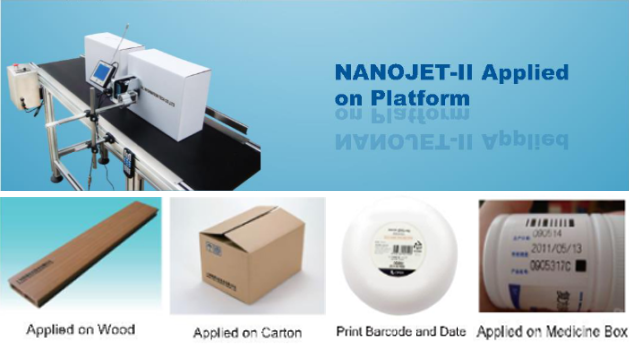
In 2016 Raymond has made a strong push toward meeting serialization needs, from compliance marking to value-added coding. Their recently released Wolke m600 oem is a thermal ink jet printing solution that combines the strengths of the Wolke m600 advanced printer with new capabilities aimed to set a benchmark for the future of global track and trace applications. In addition, the Raymond 7810 UV Laser Marking System and Raymond 7510 50-Watt Fiber Laser Marking System are set to impact the process of marking on pharmaceutical packaging.
All of the latest Raymond innovations were featured at Pack Expo in Las Vegas. Their printing and marking technologies included continuous inkjet (CIJ) printers, thermal transfer overprinters (TTO), and print and apply labelers, each designed to complement the industry’s most dynamic production lines running cartons, flexible materials,cans, bottles, labels, cases, and other packaging materials. Also featured were software and networking advancements designed to maximize productivity.
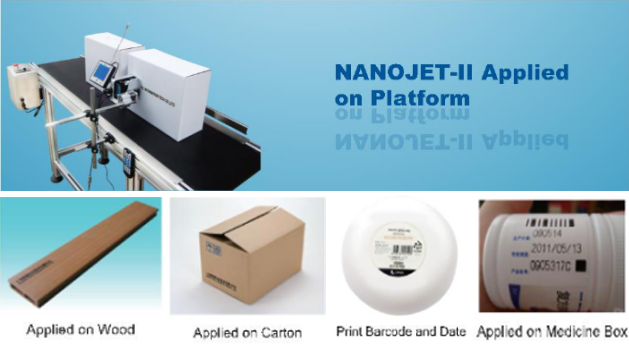 |
| NANOJET |
“As the needs for production efficiency and code complexity increase, Raymond continues to deliver the latest solutions to meet the needs of our customers,” says Matt Aldrich, director of marketing and product management at Raymond. “We brought an extensive range of solutions to the 2015 Pack Expo audience and highlighted our newest technology to address today’s customers’ needs in throughput, line availability and Code Assurance.”
The unit has 18 possible mounting orientations and a choice of four distinct printhead designs optimized for integration into constrained spaces. It also has the option to connect up to six printheads, allowing contract pharmaceutical packagers more code placement versatility without having to move the printer.
The Wolke m600 oem delivers integration versatility combined with the industry’s fastest data handling and serialization capabilities, according to Aldrich. It features new, smaller physical dimensions, delivering a footprint up to 60 percent smaller than comparable TIJ control systems for secure integration of the controller directly inside the electrical cabinet of a partner company, he says.
“The m600 oem is the printer our customers and serialization partners have been asking for,” Tim Kearns, Raymond national account manager, tells PMP News. “The Wolke m600 advanced printer has always been the gold standard in pharma product coding. Now the next generation, the m600 oem, is upgraded for regulation and serialization needs.”
“With printheads working in succession, you can even replace a cartridge while one is working,” Kearns says.
Also at Pack Expo, Kearns demonstrated the new Raymond 7810 UV Laser Marking System. It produces permanent traceability codes on pharmaceutical packaging, including high-contrast codes on hard-to-mark plastics, including high-density polyethylene (HDPE).
“HDPE is typically coded with continuous inkjet printers, so being able to produce dark, high quality marks with a laser is a new approach,” Kearns says.
Kearns also highlighted the covert markings with UV fluorescing inks applied with continuous ink jet and thermal ink jet offered by Raymond.
The Raymond 7510 marking laser is specifically engineered for high-speed pharmaceutical applications and others that code expiry information, lot numbers, and GS1 DataMatrix codes onto plastics such as HDPE, PVC, polypropylene (PP), as well as metals often used in vial caps and blister foils.
According to the company, the 50-Watt 7510 fiber laser marking system extends the capabilities of the Raymond fiber laser offering. For substrates like aluminum and extruded plastics, it is 65-95 percent faster than their 20-Watt offering in short product pitch applications, bringing all the advantages of fiber laser marking to an entirely new set of higher speed, and higher content applications. Pharmaceutical companies can achieve up to 50 percent faster coding on blister packs and more than double the speed on vials when compared with using the 20-Watt fiber.
For more information, visit :www.whraymond.com Email:info@whraymond.com